Last week, Menos AI was honored to win the Shark Tank competition at the Fixed Income Leaders Summit in Boston. It was a meaningful moment for our team and a validation of the problem we've been solving for our clients.
But the win wasn't what stayed with us.
What stayed with us was the conversation happening in the room. Those attendees who participated in the start-up focused session and engagement forum. Those who visited Booth 22. The practitioners who stopped us in the hallway (unprompted) to say what we were describing matched exactly what they were dealing with every day.
That told us something important.
Fixed Income Has an Intelligence Problem
Fixed income is one of the most information-intensive markets in the world. Hundreds of data sources. Constant narrative shifts. Analyst judgment that's difficult to capture, track, or scale. And for decades, the infrastructure hasn't kept pace.
Research floods inboxes every morning across morning notes, sell-side commentary, macro views, internal analysts' calls. The challenge has never been a lack of information. It's that valuable insights get buried, overlooked, or context lost entirely when the analyst who held them walks out the door.
And it's not just a research problem. Execution desks face the same fragmentation... needing to act on ideas faster, with in-depth context for specific issuers and liquidity conditions, often without time to surface the underlying analysis that generated the trade.
The market has tolerated this inefficiency for a long time. That's changing... and faster than most people expect.
 Augmentation, Not Automation
The next generation of institutional investment intelligence won't just retrieve information. It will remember it. Connect it. Build on it over time.
The firms that win won't necessarily have more analysts or larger execution desks. They'll have teams that are better equipped, better informed, and operating with institutional memory that compounds rather than resets every time someone leaves or a new inquiry comes across the desk.
AI in fixed income isn't about automation for its own sake. It's about giving every practitioner the tools to match the complexity of what they actually do. For research teams, that means capturing conviction and tracking ideas with full lineage. For execution desks, that means faster access to the research and context behind a trade idea, so the desk isn't executing blind and the feedback loop between research, portfolio construction, and trading actually closes. Tools built with domain knowledge, not retrofitted from general-purpose or equity-anchored solutions that are missing critical institutional depth.
The most consistent thing we heard in Boston, from across the desk, was this: we're not looking to replace human judgment. We're looking to make it better.
Sonαr was built on that premise.
Systematic 2.0: Narrative Factors
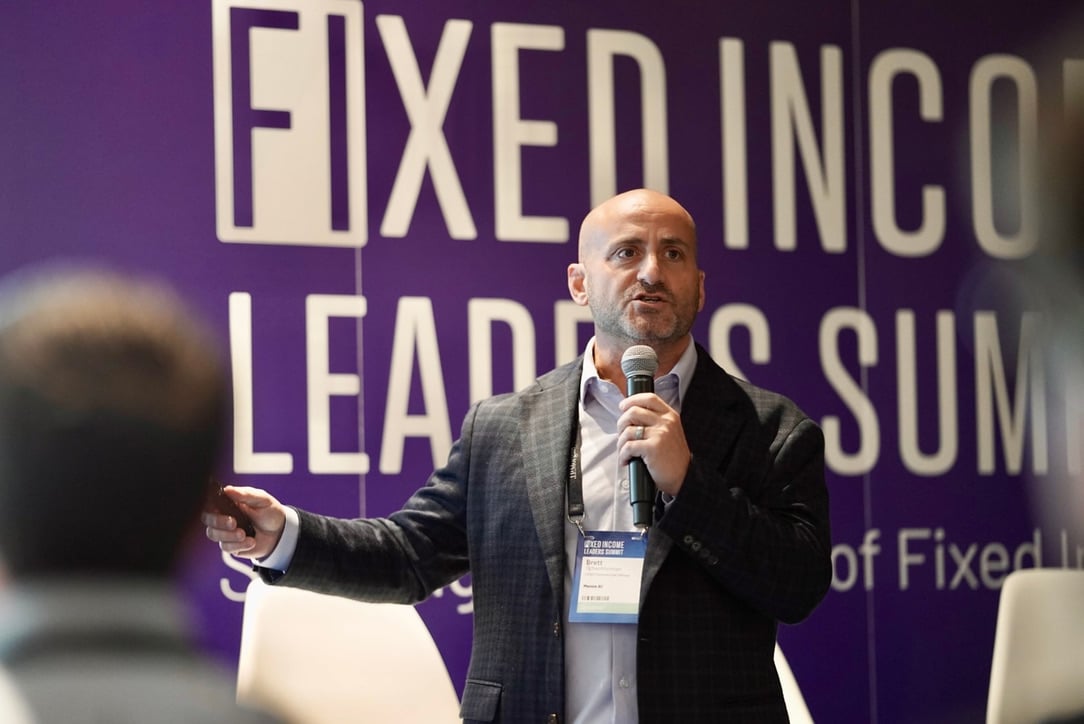
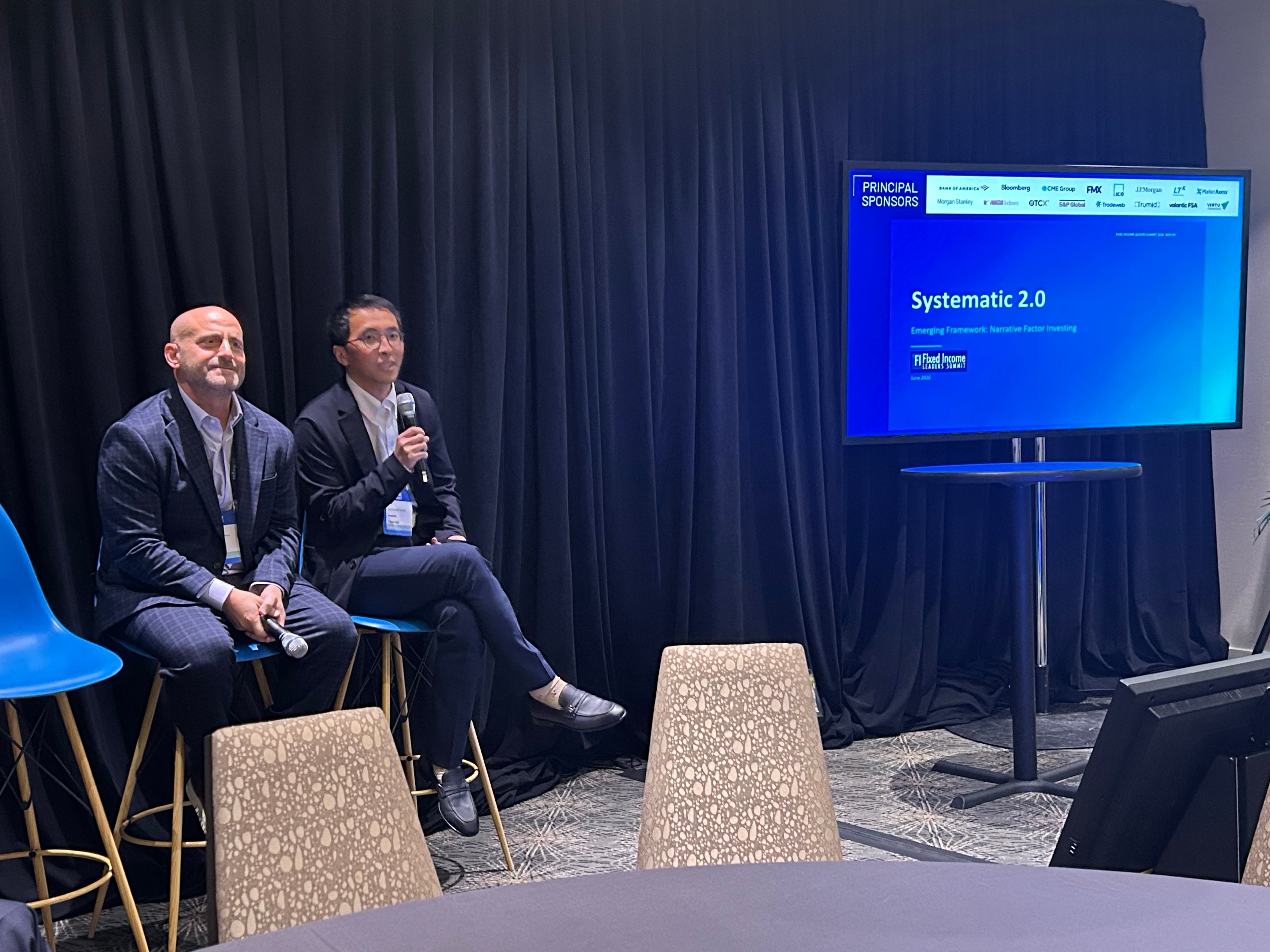
On Wednesday, our Chief Commercial Officer, Brett Schechterman, joined forces with Max Yu, Fixed Income Strategist at Vanguard, to deliver a presentation titled "Systematic 2.0: Integrating market narrative factors to improve alpha generation and portfolio adaptability."
We broke down how the industry has officially entered the AI-Augmented Research Era, where structural advantage belongs to firms that can systematically track shifting market expectations before they manifest in standard price feeds . Traditional factor models rely on backward-looking return covariation and structurally fail when uncertainty peaks because their parameter estimates stabilize too late. By contrast, Narrative Factors leverage NLP and agentic AI to process forward-looking market discourse in real time, capturing macro expectations and catalysts before affected assets begin to co-move. To make this data systematically actionable, we run raw analyst text through a strict Three-Part Filter requiring a forward-looking subjective view, a single clear target entity, and an explicit cause-and-effect rationale.
This methodology unlocks powerful, real-world portfolio applications. For alpha generation, tracking the real-time velocity of analyst language surrounding an emerging catalyst cleanly anticipates market repricing well before standard price action signals a trend. For risk management, narrative factor decomposition isolates hidden macro drivers from an original investment thesis. This prevents blind, premature exits at standard take-profit targets, helping portfolio managers distinguish between raw thematic repricing and true thesis validation to manage risk and size positions with precision.
 From Pilot to Production
Winning a Shark Tank competition is a moment. What comes after is what matters.
The fixed income industry is littered with AI pilots that never made it to production. And when you talk to the people running those desks, the reason is rarely the technology itself. It's that the technology never actually fit. Another chatbot sitting on top of a siloed data set. Another open tab with no context for what the desk is trying to accomplish. No connection to the workflows, the data, or the outcomes that matter.
Practitioners are busy. They don't have time to translate between systems. The intelligence has to flow from morning research through portfolio construction to the trading desk, and it has to do that without creating new friction, new compliance exposure, or new infrastructure headaches.
That's the problem we set out to solve with Sonαr. Not by building another general-purpose AI tool and pointing it at financial data, but by designing three proprietary intelligence modules specifically for how macro, fixed income, and multi-asset teams actually work. Trade Idea Hub, Narrative Frontier, and Voice Scoring. Ideas captured with full lineage. Narratives tracked as they develop. Conviction scored and attributed across the desk. All of it connected to the data sources your team already relies on, secured within your own infrastructure.
The firms that get this right first, with workflows that are genuinely integrated, auditable, and built for the realities of institutional investing, will compound an intelligence advantage that's very difficult to replicate from behind.
We heard that clearly in Boston. The demand is real. The timing is now.
A Note of Gratitude
Thank you again to the Fixed Income Leaders Summit — Julia Streets, Steve Toland, and the collective WBR team — for creating a forum where the exposure and the conversation can happen at the right level, with the right people.
And to the fixed income community: the honest, substantive dialogue we had in Boston is exactly why this work matters.
We're just getting started.