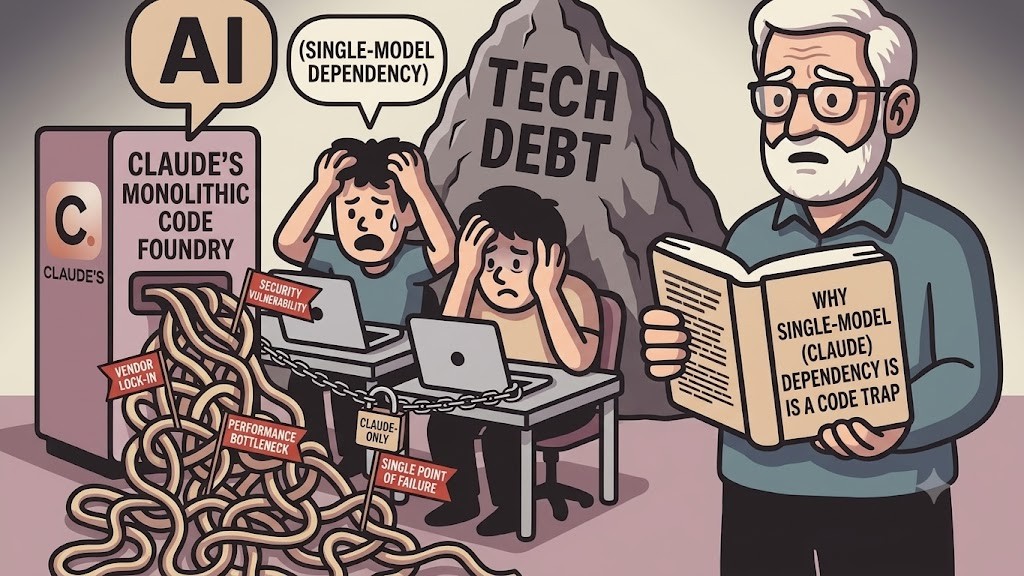
Why "Just Build on Claude" is the Riskiest AI Strategy in Asset Management
I was at FILS last week, the Fixed Income Leaders Summit, one of the most prominent buyside gatherings of industry minds every year. Almost every conversation lands on AI now. But one story has stayed with me, because it got a real laugh from the room, and the laugh was the kind people give when something is funny because it is true.
It came from the head of technology at a trillion-dollar asset manager: A portfolio manager flies to a conference, watches a polished demo, and flies home electrified. Monday morning he is standing at the technology team's desk: "I saw something incredible. I can build it myself with Claude. I just need an MCP connection and API access to our data."
That exact conversation, the executive said, is now happening at every asset manager, every single day. Then he delivered the punchline that got the room: "We can't give you that data access. Frankly, just stop going to conferences. They sell you the dream up there, and none of them have to live with the implementation." He was half joking. The other half is the precise bind the entire industry is sitting in right now.
The Reality the Demos Skip
Bottom-up AI adoption does create real, local wins. An analyst automates a grind, a desk ships a dashboard, and time gets saved. None of that is fake. But stack a hundred of those efforts across a firm with no central control, and you have not built an AI strategy. You have built a governance problem that compounds quietly until something breaks.
The same three failures show up at firm after firm.
The prototypes are toys. Claude Code can make a portfolio manager look like a staff engineer for an afternoon, and the dashboard demos beautifully. Then you look underneath: no real data connection, no integration, no security model, nothing built to survive production. Weeks of effort go into something that never leaves the laptop it was born on.
The few that work can become an operating hazard. Picture a hundred analysts each wiring their own MCP servers and API hooks into firm data. Now the data team needs to rename one column. They can't, because nobody knows which of a hundred undocumented downstream workflows it will silently break. Local autonomy quietly becomes systemic fragility.
All of it sits on a single point of failure. When the underlying model goes down, every one of those workflows goes dark in the same instant, and you learn about it from a vendor status page instead of from your own systems.
That last failure stopped being hypothetical less than two weeks ago. The Most Powerful Model on Earth Went Dark in 72 Hours. Anthropic shipped Claude Fable 5, its most advanced public model ever, state-of-the-art across the benchmarks. It went live on a Tuesday. By Friday it was gone.
On Friday, June 12, a US export-control directive forced Anthropic to disable Fable 5 worldwide, effective immediately. The model wasn't bad. It was brilliant. It vanished in 72 hours for reasons entirely outside the control of the firms relying on it. No price warning, no deprecation notice, just a government letter on a Friday afternoon.
If asset managers thought a sudden regulatory freeze was a rare anomaly, last week's global Anthropic outage delivered the operational reality check. When Claude's systems went down across production APIs, web interfaces, and automated workflows at the same time, firms that had standardized entirely on a single vendor watched their internal research pipelines halt before lunch.
If your AI strategy was simply "we run on Claude," you found out your investment process had broken from a status page. A single model is a single point of failure, and the failure rarely comes from where you are watching.
This points to a sharper bind. Sit out frontier AI and you fall behind. Adopt it blindly and you have tied your core process to an infrastructure that can reinvent itself or go dark overnight. An asset manager's expertise, however deep, is built for navigating markets, not for tracking a technology that changes underneath you every few weeks. That is the real dilemma. The way out is not to pick the winning model. It is to stop having to.
The Reflex That Feels Smart and Isn't
The scene is familiar. AI is disrupting our industry, Claude is the best on the market, and it ships ready-made agents and tools now too, so let's standardize on it and call that our strategy. It feels decisive. It is the path of least resistance dressed up as a decision.
Just as you would never put a client's entire book into a single name and call it a portfolio, concentration risk is the first thing you would flag in anyone else's process. Running everything on one model from one vendor is exactly that: an undiversified, single-counterparty position where you do not control the counterparty.
The answer is not zero exposure. It is a diversified book with an orchestration partner whose job is to manage it. You diversify capital as a discipline. You should diversify your intelligence the same way, using an infrastructure layer that routes across models and swaps them underneath you. When a single vendor suffers an outage, raises prices, or changes its roadmap, that should not become your problem.
We build on top of Claude and other flagship models, and we use the horizontal tools the labs ship: agents, connectors, all of it. We want them to keep getting better, and they will. But raw model access is fast becoming a commodity. The frontier is crowded, leadership leapfrogs monthly, and basic agent templates are just off-the-shelf blocks that any competitor can grab. The durable advantage was never the engine or the parts kit around it. It is the institutional car you build.
A model is an engine. An end-to-end research workflow is a car. An engine bolted to a workbench is brilliant but useless. You can’t drive it to a client meeting, and you can't put a portfolio manager behind the wheel. Buying a great engine, even with a box of parts, and calling it a strategy is how firms end up with an expensive asset that goes nowhere.
Consumer AI Is "Success-Critical", Institutional Research Is "Failure-Critical"
This is the part most firms miss, and it matters most. Agents have stopped just talking and started doing. They move files, send emails, pull together research, and automate the work that used to eat an analyst's morning. That changes the operational bar completely.
As a consumer, Claude is a success-critical tool. You ask ten things, two answers come back excellent, you keep those and toss the rest. The wins are what count.
A production research system is failure-critical. It has to run a thousand times and be right a thousand times, because the one time it sends a corrupted figure to a client or invents a line item in a research note is the time that defines it. The other 999 flawless runs do not earn it back. A self-driving car that handles 99,000 miles flawlessly and crashes once is not a great car. It is an unusable one. Consumer AI is judged by its best answer. Institutional AI is judged by its worst.
A failure-critical system has to get five architectural dimensions right that a raw model or general-purpose AI product cannot deliver on its own.
-
Resilient. It cannot go dark when a single vendor or API layer goes down.
-
Right and provable. It must be strictly correct and able to show why.
-
Complete. It must avoid confident summaries built on half the evidence.
-
Governed. It must remain defensible, access-controlled, and fully auditable.
-
Scaffolded for complexity. It must be engineered to handle the endless edge cases of real-world workflows.
Those are the five layers. Here is where a "just build on Claude" strategy quietly falls short on each, and how the Menos AI tech stack is built to insulate your process.
The Five Institutional Infrastructure Layers
1. Evaluation and Smart Routing: Resilience and Freedom from Model Lock-In
The failure this prevents: Going completely dark during a single-vendor crash, or sending a high-value task to a model ill-equipped to handle it.
The reality: No single model wins every capability, and the leaderboard reshuffles constantly. As of June 2026, Claude Opus leads on complex coding, Gemini on massive context reasoning, and GPT-5.5 acts as an agentic all-rounder, while a tier of cheaper models delivers utility at a 10x cost reduction. In six months that ranking will look different again.
The Menos advantage: Standardizing on a single provider means inheriting their outages, price shifts, roadmaps, and regulatory exposures. Managing this dynamically requires continuous evaluation and benchmarking that tests model updates against real financial tasks. That is unglamorous, full-time engineering work that no asset manager is staffed to do part-time. Our orchestration layer pairs each task with the most resilient, cost-effective model and benchmarks them continuously. Because the stack decouples the application from the underlying provider, last week's Claude outage did not freeze our clients' research workflows. The system silently rerouted active tasks to alternative frontier models with no data loss and no user friction.
2. Accuracy and Explainability: Being Right, and Proving It
The failure this prevents: A confident, fluent answer that is simply wrong, or correct but impossible to defend to a risk committee or client.
The reality: Fluency is dangerous. A mid-2026 benchmark found that four out of six leading models fabricated figures when source data had gaps, doing it with the same professional polish as the truth. A wrong number that looks right is worse than no answer. It infects memos, meetings, and positions.
The Menos advantage: We do not rely on a raw model's generic compliance. The platform enforces continuous verification against source documents. Every claim is grounded in structured, dated materials and traceable back to the originating note. If information is missing, the system surfaces what it could not substantiate rather than guessing. Firm-specific definitions, such as conviction scores or windowed z-scores, are encoded at the infrastructure level, so the output stays consistent whether you run it in January or June. Every conclusion carries a complete audit trail, the defensibility a fiduciary requires.
3. The Institutional Context Layer: Complete Answers, Not Partial Syntheses
The failure this prevents: A polished, articulate summary built on whatever documents the model happened to find, missing critical internal data and never telling you.
The reality: A raw API reads what you hand it in the moment and forgets it the second the session closes. The obstacle is not access. It is that raw institutional research is not formatted for an AI model to use consistently, comprehensively, or affordably.
The Menos advantage: We build a dedicated, compounding institutional context layer. First, we preprocess research: sell-side notes, filings, transcripts, and internal commentary are structured, classified, and indexed the moment they arrive, turning thousands of documents into a unified, queryable structure so agents do not re-parse raw text every time. Second, we enable compounding institutional memory. Complex questions, such as how a desk's conviction on a credit name evolved over six months, cannot be answered from a snapshot. Each document processed enriches the system, creating an evolving internal intelligence asset rather than an interface that starts from zero every morning.
4. The Last Mile: Governance, Entitlements, and System Integration
The failure this prevents: Delivering the right answer to the wrong person, through a black-box process compliance cannot audit, in a separate tool analysts refuse to open.
The reality: This is where internal AI builds quietly stall. A model means nothing if it is not wired into the data feeds, document repositories, identity entitlements, and security perimeters your firm already runs on.
The Menos advantage: The frontier labs ship horizontal building blocks. The burden of assembling, securing, and integrating them into an enterprise environment is left entirely to you. Menos AI delivers the finished last mile. The platform is built around strict data access scoping that matches your existing infosec and compliance requirements, and it integrates directly inside the workflows and communication tools where your analysts already live.
5. The Scaffolding of Complexity: Why Financial Agents Require Infrastructure
The failure this prevents: A system that works flawlessly in a controlled executive demo but shatters the moment it meets the messy, non-standardized reality of live financial workflows.
The reality: Building production-grade agents is an ongoing software problem. Reliability does not come from the model alone. It comes from the scaffolding around it: routing, evals, retries, permissions, monitoring, human-in-the-loop review, and exception handling.
The Menos advantage: In institutional credit and asset management, corner cases are not cosmetic bugs. They involve resolving non-standard bond tickers, reconciling conflicting data across disjointed providers, handling compliance-sensitive language, managing restricted security lists, and isolating stale data. The hard part is not writing an API call to Claude or GPT. The hard part is building the domain-aware software wrapper that forces these models to behave correctly, predictably, and auditably across thousands of messy, real-world cases.
The Token Bill Nobody Budgeted
Runaway infrastructure cost is quietly derailing internal projects. The corporate examples are stacking up. Uber burned its entire 2026 AI budget in four months, with its COO noting that the link between the spend and customer value "is not there." Market analysts project a 24x explosion in token demand by 2030 and warn that falling model prices will not save budgets, because complex agents consume far more tokens per task than price cuts offset. This compounding cost shows up when a firm's architecture forces every query to dump raw documents back into a frontier model, paying to re-read everything from scratch.
The Menos tech stack flattens that cost curve with three native mechanisms.
-
Smart routing. Basic tasks like classification, extraction, or initial summarization do not need the most expensive flagship model. We route those to lighter, cheaper endpoints and reserve frontier reasoning for where it moves the investment answer. Matching tasks to the lowest cost-effective quality tier eliminates runaway spend.
-
Preprocess once, reuse everywhere. Because the institutional context layer structures and indexes documents at ingestion, queries hit clean data instead of raw text. You pay for the heavy context lifting once, and the entire firm draws on the structured result for free.
-
Prompt caching. A stable, structured context layout maximizes native prompt caching, capturing up to a 90% discount on repeated inputs.
Chat is metered by patience. Production agents are metered by capital.
The Bottom Line
"Just build on Claude" is the AI equivalent of running an unhedged, concentrated, single-counterparty position. It feels fast at the start, but it is operationally fragile. It puts a success-critical tool where your business requires a failure-critical system.
Your firm's structural edge is picking assets, managing risk, and generating alpha. It is not maintaining inference pipelines, tracking API deprecations, or re-engineering prompts every time a provider updates its backend or goes down for maintenance.
Use the best specialized model for the task at hand, whether that is Claude, Gemini, or GPT. But deploy them inside an infrastructure layer you control: one that routes intelligently, avoids vendor lock-in, verifies its claims, compounds institutional memory, and stays online when a single vendor has a bad day.
Already shipped. Already powering live research workflows through earnings. Already compounding.
Claude builds (one of) the engines. We build your car.